

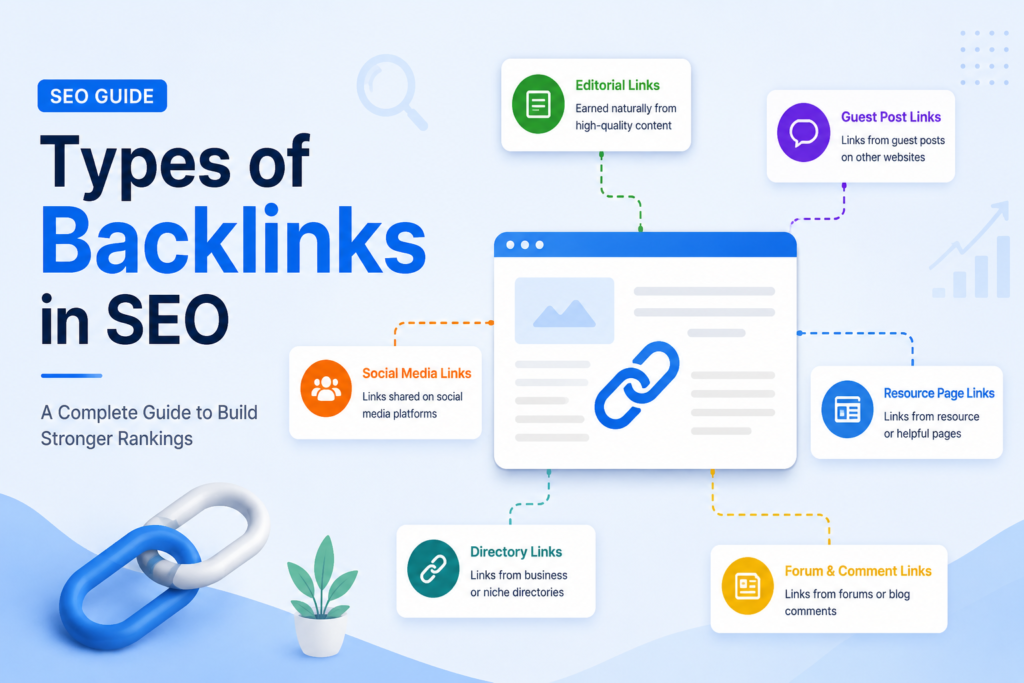
Backlinking has always been part of SEO; however, just acquiring links won’t guarantee a higher ranking. Some links will enhance website authority, while others might have only a minimal effect or even cause issues. Knowing the different types of backlinks can guide you in focusing on link-building avenues that will not only support your growth in the short term but also be with you over time.
Inexperienced people might find link building a maze, since backlinks vary in reliability, authority, placement, and overall SEO value. This article presents the main backlink classifications, clarifies how they affect backlinks for SEO, and lists common errors to avoid when building one’s backlink profile.
What Are Backlinks and Why Do They Matter for SEO?
Backlinks are among the most important factors that not only determine a website’s ranking but also help search engines assess the quality and reliability of that site.
What Is A Backlink?
It is common for people starting to learn SEO to ask, what are backlinks, and why are they so important. Simply put, a backlink is created when one website includes a link to a page on another website. For example, if a marketing blog mentions your article and includes a link to it, that link is a backlink. Such links not only help users find additional information but also signal to search engines that other websites value your content enough to refer to it.
Why Backlinks Affect Google Rankings
One reason Google and other search engines monitor backlinks is that they can be a strong signal that a page is well-designed, valuable, and worth recommending. In fact, the more a site is linked by reputable and authoritative sources, the more credible and trustworthy it becomes in the eyes of the search engines. Besides making your page discoverable by search engines, linking also serves as a clue about how different web pages are connected to one another. Apart from the benefits for rankings, they may also drive visitors to your website by sending them directly from other websites.
How Search Engines Evaluate Backlinks
Simply having a backlink does not mean it holds a certain value. Besides assessing whether the linking is relevant, search engines also consider the site’s reputation, which is determined by the accumulation of quality links over time, as well as its level of trustworthiness. The placement of the link on the digital page, the anchor text, and the link’s natural appearance are additional criteria taken into account. Thanks to these factors, backlinks in SEO may be the reason why one or two great backlinks can have more influence on your website domain than a hundred mediocre ones.
Understanding the Different Types of Backlinks in SEO
Most people, when discussing link building, assume that all links are alike. As a matter of fact, certain types of backlinks are way more valuable than others. Some links will enhance a site’s authority, whereas others will just contribute to exposure or traffic. It is highly beneficial to familiarize yourself with different backlink categories and their potential for your SEO strategy before you start link building.
DoFollow Backlinks: The Links That Pass SEO Value
A DoFollow backlink is the type of link that search engines usually crawl and consider when determining a page’s authority. When a site links back to your page with a DoFollow link, part of its trustworthiness is carried over to the linked page, thus search engines get a signal that the content has been cited by another source. This is the reason why DoFollow links tend to be the highest quality links you can get in SEO campaigns. They are typically acquired through methods such as guest posting, receiving article mentions, being listed on resource pages, and getting references from industry publications that link to valuable or relevant content.
NoFollow Backlinks: Do They Still Matter?
Nofollow links, which have long been a topic in SEO, are still widely misinterpreted. Such links consist of a tag that tells search engines not to consider them regular ranking links. This, however, shouldn’t be taken to mean that they have no value. For instance, a link in a forum thread, a blog discussion, or on a social media post can direct visitors to your site and, at the same time, raise your brand awareness. Besides, these links give your backlink profile a more natural appearance, since websites rarely get only DoFollow links.
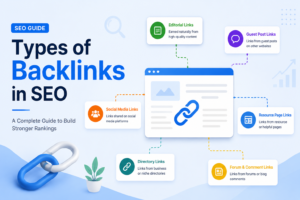
Editorial Backlinks: The Most Valuable Links You Can Earn
When another website references your content without prompting, that is an editorial backlink. Typically, these kinds of links occur when the content provides information that either supports the article, answers a question, or supports a topic under discussion. Since the linking site decides on its own, search engines tend to regard editorial backlinks as strong indicators of trust. Examples of content that may lead to such natural mentions are original research pieces, survey data, industry reports, expert quotes, and exclusive information.
Guest Posting Backlinks: A Trusted Way to Make Links
Backlinks from guest posts are those links that you earn by writing an article for another website. Instead of waiting for other sites to find your content, guest posting lets you share your expertise with a relevant audience and get a backlink as a bonus. That is one reason this strategy remains a preferred way to build backlinks in SEO. First of all, it helps to get the brand name out there. Besides that, positioning your site in front of readers who are already interested in the subject can lead them to visit your site. Also, a guest article on a well-known industry site can boost your authority and attract the right visitors for a long time after publication. So, basically, go for the sites that have real followers, create content in line with their standards, and pick the themes that naturally relate to your niche.
Niche-Relevant Backlinks: Why Industry Relevance Matters
Consider an example in which an accounting firm’s tax-planning guide is linked from two websites: a finance blog and a travel destination website. As backlinks, both links have value, but the one from the finance blog will carry more weight, as the subject matter is closely related in the first case. Search engines tend to consider such associations while evaluating links. Having links from websites that not only belong to the same industry but also discuss similar topics is a great way of establishing your line of work to your potential customers. Besides, these are the kind of backlinks that bring in visitors who will likely become your customers, making them experts in both SEO and your audience.
High-Authority Backlinks: Building Trust With Search Engines
Having a backlink from a website that people already know and trust can result in a much better effect than being linked by a few lesser-known ones. Authorities are generally established gradually through consistent factors such as content quality, reputation, expertise, and audience trust. Therefore, getting connected with major industry publications, well-known blogs, university websites, and government resources is a highly desirable situation. When those websites link to your content, it becomes a great way of indicating that you deserve to be noticed, which is the reason why most search engines will recognize your website as a dependable source in the field.
Resource Page Backlinks: Getting Featured on Helpful Industry Lists
Basically, a resource page is you being a good host by sharing information that your visitors find useful. You have probably run across pages named “Recommended Resources, ” “Helpful Tools, ” or “Useful Links” while visiting industry sites. Including your material on such pages means your content will be seen by the very people who are interested in solutions and information. Besides providing traffic, these links also offer the potential for continuous traffic generation, which is why companies really like them. Naturally, you must have something worthy of a recommendation, such as an advanced guide, unique research, a complimentary tool, or any other type of resource that genuinely meets a need. You often just need to send a well-crafted email to the right person.
Business Profile Backlinks: Strengthening Your Online Presence
One of the easiest ways to get backlinks is to make a business profile on trusted portals. Typically, such profiles feature your company name, website, business phone number, and a brief explanation of what you do. A directory entry might not have the same level of impact as a link from a leading publication, but it does help search engines puzzle out if your business is real and functioning in a particular industry. Being listed on business directories, professional bodies, and industry-specific platforms can also give your brand a higher profile for potential customers, especially when they are looking for suppliers in a given location or sector.
Social Media Backlinks: Expanding Reach Beyond Search
A link shared on social media is far more likely to be seen than a link buried quietly on a website. Whether it is in a post on LinkedIn, a thread on X, a status update on Facebook, or a different platform, the main goal is still to get the content exposed to, and thereby possibly useful for, the people. Most social media links do not carry significant SEO authority; however, they can boost a specific piece of content. Greater exposure can indirectly lead to sharing, which leads to more discussions, and sometimes even to mentions from bloggers, publishers, or websites that reference the content in their own articles.
Forum and Community Backlinks: Building Visibility Through Participation
People have been using online communities as meeting points to give and get recommendations, find solutions, and discuss what they like. By dropping a relevant link in a forum thread or an answer on a Q&A platform in a way that helps users without sending them on a fruitless search, you provide them with a better experience. These backlinks have their best effect when they are natural parts of meaningful comments rather than insertions of marketing slogans. Industry-specific forums, groups on social media, and Q&A platforms can all serve as sources of good traffic if the shared content is a good fit for the ongoing discussions.
Image Backlinks: Earning Links Through Visual Assets
One of the types of backlinks is image backlinks, which are created when other sites use a visual asset and link to the original source. People are naturally drawn to visual content since it can help explain complicated information and make it easier for readers to comprehend the content. Infographics, charts, statistical visuals, and hand-drawn images are only a few of the types of content shared widely across websites, blogs, and articles. These exchanges can result in valuable backlinks and increased content exposure at the same time, provided proper credit is given.
Press Release Backlinks: Turning News Into Link Opportunities
Press release backlinks are links from press releases distributed to media, news websites, and industry publications. A press release is a communication tool used by companies to announce things like product launches, new partnerships, company milestones, and interesting research. In general, the SEO benefit of direct links from press releases is not very consistent, but the media exposure generated by a press release can motivate journalists, bloggers, and content creators to cite the story on their websites. Typically, these subsequent citations are the most valuable backlink opportunities.
Broken Link Backlinks: Helping Sites Replace Dead Resources
If you decide to pursue broken link building, you will find that it involves identifying online links that refer to a web page that has been removed or is unavailable, and offering to replace it with one of your own. Fixing a problem on a web page is an opportunity for a site owner when a visitor points out a broken link. Broken link building is actually quite a simple model: you find a broken link, contact the site owner, and offer to replace it with a link to your page. In fact, it can get you not only a relevant backlink but also industry contacts and mutually beneficial outreach conversations.
Which Types of Backlinks Deliver the Best SEO Results?
It really matters where a backlink originates and why the link is being left. One citation from a well-regarded site in your field might be even more helpful for SEO than a bunch of links from totally unrelated places. Generally, links that are connected to your area of expertise, naturally integrated in the text, and obtained from trusted sites are likely to give the highest SEO results. Knowing which backlinks are most important can help you target your efforts more confidently.
Toxic Backlinks: Links That Can Hurt Your Rankings
Backlinks are generally considered top SEO indicators. But they do not always play a positive role. Links originating from a site that was just created to trick the system, pages loaded with spam, or sites that have absolutely nothing to do with your business can be very problematic for link quality. A rapid growth in suspicious links may well be against your SEO strategy and, in fact, make it harder for you to keep a clean backlink profile. Monitoring the sources of your links is equally important as acquiring new ones.
Common Backlink Building Mistakes Beginners Should Avoid
It can be quite time-consuming to build backlinks. Yet, new learners sometimes get easily convinced and consequently make decisions that are quite okay in the short run but result in futile efforts in the long run, adding value.
- Before pursuing the backlink opportunity, check if the website is of good quality.
- Simply put, do not choose the websites just because they offer you a good and easy way to get backlinks.
- Never add links to websites that have nothing to do with your topic or are completely irrelevant to it.
- Anchor text should not just be considered as your only ranking strategy, but as a way to assist readers.
- After all, do not expect your backlinks to perform well if the content that is linked to is of very little value.
- Stop looking at backlink numbers alone. Instead, think about relevance, trust, and context.
Build High-Quality Backlinks More Efficiently With LinkMetrics
Discovering suitable websites, assessing their quality, and handling outreach can be very time-consuming. LinkMetrics makes it easier for businesses, agencies, and marketers to connect with a wide range of verified publishers engaged in various industries. Instead of working laboriously to uncover opportunities, users can simply compare websites, check main SEO metrics, and find placements that meet their criteria. If a brand is considering strengthening backlinks for SEO, LinkMetrics is a perfect tool for selecting high-quality link opportunities in a more orderly fashion while still adhering to relevance and transparency.
Conclusion
Knowing about different types of backlinks will help you to devise a link-building strategy that will support your SEO growth over the years. In fact, it is much better to prioritize factors such as relevance, authority, and overall quality rather than focusing solely on the number of links acquired. Usually, a strong backlink profile is formed via various link sources, with each one of them contributing differently to visibility, trust, and organic performance. For a beginner, the most dependable way is to earn links by producing valuable content and engaging in ethical outreach practices. LinkMetrics can make identifying quality backlink opportunities much easier by serving as a bridge between businesses and relevant publishers and facilitating more efficient link-building efforts.
FAQs
Which backlink type usually has the strongest SEO value?
Editorial backlinks, generally, are classified as the strongest ones because they are naturally awarded by the websites that decide to use the referenced content.
Is it possible to rank without building backlinks?
There is a chance to rank for some low-competition keywords even without link building. However, backlinks become increasingly important as competition gets tougher.
What makes a backlink more valuable than another?
There are many factors that determine the quality of a backlink. These include: whether the link is relevant to your niche, how reputable the source site is, the quality of the content, and the extent to which the link is integrated into the page.
Do backlinks lose value over time?
A backlink can remain valuable for several years as long as the linking page is live, relevant, and accessible to both users and search engines.
How can beginners start building backlinks safely?
Producing high-quality content, writing guest posts on websites related to your niche, and getting your name heard by industry sources are the most common ways to start building backlinks safely and sustainably.