
Backlinks work like references from the wider web. When credible websites link to a page, search engines get another reason to trust what the page offers. That is why dofollow vs nofollow backlinks deserves a practical look, not a simple winner-style answer.
A dofollow link can help rankings because search engines treat it as a regular editorial signal. A nofollow link works differently. It may carry less authority, yet it can still send visitors, create brand recall, and make a backlink profile look more natural.
The mistake is chasing dofollow links everywhere. Real profiles include blogs, guest posts, directories, forums, news mentions, and business listings. This guide explains nofollow vs dofollow backlinks, ratio checks, and stronger Linkmetrics placements.
What do dofollow backlinks mean for SEO?
-
Dofollow backlinks are normal web links
A dofollow backlink is simply a regular hyperlink from another website to your page. It does not need a special dofollow tag. If no nofollow instruction is added, search engines can crawl the link and treat it as a possible vote of confidence.
Dofollow links help because they show that another website found the page worth referencing. This can help a guide, product page, blog, or service page build stronger search authority.
-
Strong dofollow links depend on placement
A dofollow backlink works best when the placement feels useful. A travel blog linking to a destination guide makes sense. A software website linking to a SaaS comparison page makes sense. A business publication linking to a finance checklist makes sense.
The link still needs to earn its place. Thin, unrelated content will not carry the same value as a natural link inside a topic-relevant article. Search engines read the surrounding page, anchor text, topical connection, and website quality.
-
Dofollow does not mean automatic quality
The phrase do follow and no follow can make SEO sound mechanical, but links are not judged by tags alone. A dofollow link from a weak website can be useless. A dofollow link from a trusted, active, niche-relevant website can support growth.
Strong dofollow links usually come from places where a link has a clear reason to exist, such as editorial articles, guest posts, resource pages, research mentions, comparison guides, expert roundups, and genuine citations.
What do nofollow backlinks mean for SEO?
-
Nofollow backlinks limit endorsement
A nofollow backlink tells search engines not to treat the link as a full editorial endorsement. Publishers use it when they want to mention another website without passing normal authority.
This can happen in comment sections, forums, sponsored posts, review pages, social platforms, user profiles, and large publishing websites.
-
Nofollow links appear across trusted websites
Many respected websites use nofollow links in certain areas because of publisher policy, not because the linked website lacks quality. A trusted industry website may still send strong traffic. A relevant community mention can put your brand before the right audience.
-
Poor nofollow links add little value
Spam comments, empty profiles, weak directories, and irrelevant forum drops rarely help. A nofollow link should still pass a basic quality check: real readers, topic match, and possible visitor interest. If that test fails, the backlink is weak.
Dofollow vs Nofollow backlinks: What is the actual difference?
-
The main difference is the search treatment
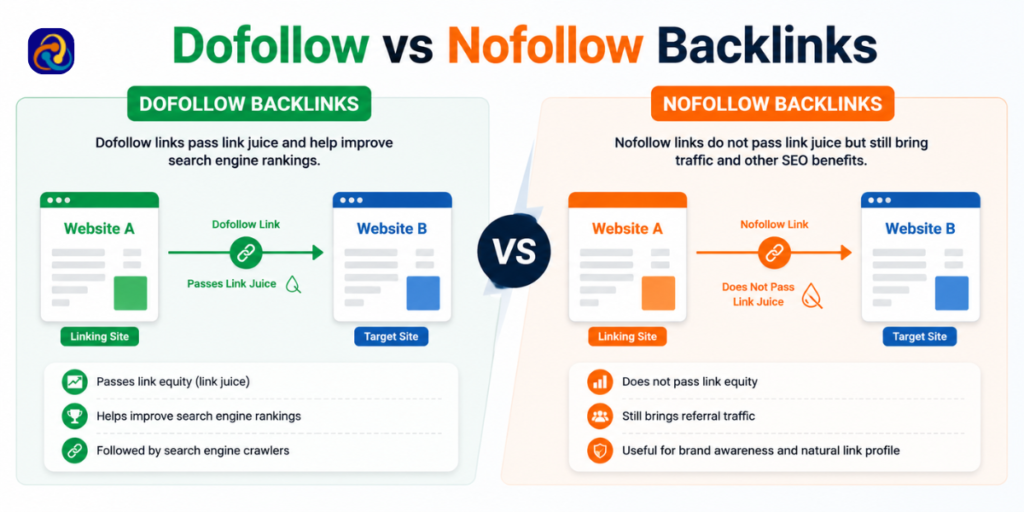
Dofollow and nofollow links differ in how search engines read them. A dofollow link can carry a stronger endorsement. A nofollow link limits that signal. Still, the tag is not everything. Source quality, placement, anchor text, traffic, and editorial fit decide real value.
-
Dofollow and Nofollow compared clearly
| Factor | Dofollow backlinks | Nofollow backlinks |
| Direct SEO value | Stronger authority signal | Limited authority signal |
| Link equity | Can pass ranking value | Does not pass full endorsement |
| Referral traffic | Can send visitors | Can send visitors |
| Common use | Editorial articles, guest posts, citations | Comments, sponsored links, forums, user-submitted links |
| Risk control | Needs careful source checks | Helps qualify uncertain links |
| Profile value | Helps authority building | Helps variety and discovery |
Are nofollow backlinks bad for SEO?
-
Nofollow does not mean worthless
Nofollow backlinks are not bad for SEO. A nofollow link may not push authority in the same way, but it can still put your page in front of readers who care about the topic.
-
Strong nofollow links can create future value
A relevant nofollow link can bring visitors who later read more, enquire, subscribe, search for the brand, or mention the page elsewhere. A blogger, journalist, or customer may first discover the content through that link.
-
Weak sources should still be avoided
Poor nofollow links from spam comments, empty profiles, weak directories, and irrelevant pages add little. Keep useful mentions. Avoid links collected only for numbers.
What is the ideal dofollow vs nofollow ratio?
-
There is no universal perfect ratio
There is no fixed dofollow vs nofollow ratio that works for every website. A travel blog, SaaS brand, health platform, local business, and B2B company will not collect links in the same way. Travel guest post sites may attract links from destination blogs, hotel listings, itinerary pages, and social profiles. A technology brand may be mentioned in software reviews, how-to tutorials, startup blogs, and comparison articles.
-
The ratio helps during audits
The dofollow vs nofollow ratio is useful when reviewing link patterns. Mostly dofollow links with repeated anchors can look planned. Mostly nofollow links may mean the site needs more editorial references. Balance simply means the link mix matches how the brand is actually being mentioned online.
-
Quality should come before percentages
A few strong links can beat hundreds of weak ones. Before chasing a percentage, check the linking site, page topic, traffic signs, anchor text, outbound links, and placement. A good backlink should make sense to a reader first.
Which link type is better for SEO?
-
Dofollow links are better for rankings
Dofollow backlinks are better for direct SEO value. They can help build authority when they come from trusted websites with relevant content. For competitive keywords, quality dofollow links can make a clear difference.
This is why SEO teams prioritise dofollow links in outreach. They help search engines understand that a page has support from other websites. The stronger the source and context, the stronger the possible value.
Dofollow links should never be chased blindly. A paid link on a weak guest post site can create risk. A natural link inside a helpful article can support growth for years.
-
Nofollow links are better for reach
Nofollow links are better for reach, traffic, and safe linking. They can introduce a brand to readers even when they do not pass full authority. They can also make the backlink profile look more natural.
A nofollow link from a respected publication may be worth keeping because people actually read the page. A dofollow link from an abandoned website may bring nothing.
This is why the link source must be reviewed before the tag.
-
The practical answer is both
Dofollow links support authority. Nofollow links support discovery and variety. A strong backlink strategy needs both, but not from random websites.
The best links come from pages your audience already reads. The link should belong in the article, help the reader, and point to a page that adds value.
How guest posts help build the right backlink mix
-
Guest posting gives more control
Guest posting can help brands build backlinks from niche-relevant websites. It gives more control over the topic, audience, anchor, and destination page.
A strong guest post starts with the reader, not the link. The article should answer a real question or explain a useful idea. The backlink should support that explanation. If the link feels like an interruption, the placement is weak.
Guest post links may be dofollow or nofollow depending on publisher policy and placement type. Editorial fit should come first.
-
Travel Guest Posts
Travel Guest Posts work for hotels, travel agencies, tour operators, destination blogs, itinerary platforms, and visa assistance brands.
A travel backlink should appear where readers expect it. A family travel guide can link to hotel advice. A destination article can link to an itinerary. A packing checklist can link to a travel planning resource.
Travel links lose value when placed in unrelated articles. Relevance is the difference between a useful backlink and a forced placement.
-
Technology Guest Posts
Technology Guest Posts can support SaaS brands, app developers, cybersecurity firms, cloud platforms, IT consultants, and software companies.
Technology is a broad niche, which makes topic matching important. A cybersecurity link should appear in content about online risk, privacy, compliance, or secure systems. A SaaS link should appear inside software, workflow, automation, or productivity content.
The best technology guest posts explain something practical. Tutorials, comparisons, implementation guides, and problem-solving articles work better than broad promotional writing.
-
Health Guest Posts
Health Guest Posts need extra care because the content can influence personal decisions. A health backlink should appear on a website with clear editorial standards and responsible wording.
Clinics, wellness platforms, fitness brands, nutrition websites, and healthcare marketers should avoid aggressive claims. The content should educate, clarify, and guide without overstating outcomes.
In health link building, trust is more important than volume. A few careful placements can be better than many weak ones.
-
Business Guest Posts
Business Guest Posts work for B2B companies, consultants, agencies, finance brands, SaaS tools, HR platforms, accounting services, and startup websites.
Business readers want practical value. They respond to guides, comparisons, checklists, case studies, calculators, and process explanations. A backlink works best when it supports a decision or solves a problem within the article.
A business guest post should feel professional, specific, and useful. Generic advice with a commercial anchor rarely works well.
How Linkmetrics provides the best backlink and guest post offerings
-
Linkmetrics makes backlink selection clearer
Linkmetrics helps brands, agencies, and SEO teams find guest post and backlink opportunities through a more organised marketplace. Its website describes access to 10,000+ human-verified websites, with SEO metrics from platforms such as Moz, Ahrefs, and Majestic used to support publisher comparison.
This matters because backlink decisions can become messy when buyers depend on scattered spreadsheets, cold outreach, and surface-level domain scores. A website may look strong through one metric and still have weak traffic, thin content, or unrelated outbound links.
Linkmetrics gives buyers a clearer way to review placement options before spending money.
-
Niche categories help campaigns stay focused
A backlink works better when the publisher matches the niche. Linkmetrics lists guest post opportunities across categories such as business, technology, SaaS, marketing, startups, health, and multi-niche websites.
This helps brands avoid random placements. A travel brand can look for travel-focused opportunities. A technology company can review SaaS or tech publishers. A health brand can choose health and wellness websites with more care. A business brand can focus on professional audiences.
This is useful for campaigns built around Travel Guest Posts, Technology Guest Posts, Health Guest Posts, and Business Guest Posts because each category needs a different publishing environment.
-
Health placements need stronger checks
Health link building needs a tighter review than many other niches. Linkmetrics highlights manual verification, niche relevance, organic growth checks, stable outbound links, and clean link profile evaluation for health guest post placements.
This is useful for health and wellness brands because poor publishing choices can weaken trust. A health backlink should not appear on a spam-heavy site or an article with careless claims.
The same quality logic applies to every niche, but health content raises the stakes. Readers need accuracy, and brands need safer placement decisions.
-
Linkmetrics supports better planning
The main advantage of Linkmetrics is control. Buyers can compare websites, review metrics, consider relevance, and plan campaigns with more structure. This does not remove the need for human judgement. It gives teams a better starting point.
A good backlink decision should check traffic signals, niche fit, editorial quality, outbound link behaviour, pricing, and anchor safety. Linkmetrics brings many of these checks into the selection process, which can reduce guesswork during guest post planning.
For brands that want a cleaner backlink mix, this structure is useful. It helps them choose placements based on purpose instead of chasing links blindly.
How to check if a backlink is dofollow or nofollow
-
Inspect the link attributes
The quickest way to check link type is to inspect the link on the page. A nofollow backlink will include a nofollow instruction in the link attributes. A regular link without that instruction is generally treated as dofollow.
This check is useful after a guest post goes live. It also helps during backlink audits, publisher reviews, and competitor analysis.
-
Use backlink audit tools
SEO tools can check link type across a larger backlink profile. They can show referring domains, target pages, anchor text, link status, and link attributes.
These tools save time when a website has many backlinks. They also help find patterns such as repeated anchors, irrelevant referring domains, and sudden link spikes.
-
Review the page context
The tag is only part of the review. A backlink also needs context. Check whether the page topic matches your website. Look at the surrounding paragraph. Review the anchor. See whether the link appears inside the main content or in a weaker placement area.
A link inside the article body is usually stronger than a link hidden in a footer, sidebar, or generic author bio. The backlink should make sense to a reader.
Common mistakes to avoid with backlink strategy
-
Chasing dofollow links at any cost
Many campaigns become weak because every decision is built around dofollow links. This can push brands into irrelevant guest posts, low-quality publishers, and repeated anchor patterns.
Dofollow links are important, but source quality decides their value. A forced dofollow link can create more risk than benefit.
-
Ignoring nofollow links completely
Rejecting nofollow links without checking the website can cost useful traffic. A nofollow mention from a strong platform can still bring readers and brand recognition.
Nofollow links can also make a backlink profile look more natural. Real brands get mentioned across platforms with different link rules.
-
Repeating exact-match anchors
Exact-match anchors should be used carefully. Repeating the same keyword across multiple websites can make the profile look artificial.
A safer mix includes branded anchors, partial-match anchors, plain URLs, page titles, and natural phrases. Anchor text should read like part of the sentence.
-
Choosing websites outside the niche
A backlink needs a topic connection. A health link in a random entertainment article looks forced. A technology link in unrelated lifestyle content may bring little value. A business link on a thin general blog may not reach decision-makers.
Niche fit should come before domain metrics.
-
Skipping publisher quality checks
Before placing a backlink, review the publisher. Check content standards, topic focus, traffic signs, outbound links, publishing frequency, and audience match.
Avoid websites that publish unrelated guest posts in bulk. These sites may offer easy placements, but they rarely support long-term SEO growth.
How to build a natural backlink strategy with both link types
-
Start with the right sources
A natural backlink strategy begins with source selection. Ask whether the website belongs in your market before asking whether the link is dofollow.
A relevant website gives the backlink a stronger base. The topic, reader, and linked page should connect clearly.
-
Use dofollow links for authority
Dofollow links should come from trusted guest posts, editorial citations, expert contributions, resource pages, research mentions, and useful guides.
These links help build authority when the source is credible and the placement feels natural. They are important for competitive pages that need stronger ranking support.
-
Use nofollow links for reach
Nofollow links should be accepted when they come from visible, relevant, and trusted sources. They can bring traffic, recognition, and profile variety.
A nofollow link from a strong industry website can still support the wider search picture. It can introduce your brand to readers who may later search, share, or cite your content.
-
Keep growth steady and anchors varied
Backlink growth should look steady. Sudden spikes from weak websites can create problems. A cleaner strategy combines guest posting, digital PR, partnerships, expert quotes, resource outreach, and useful content assets.
Anchor text should vary naturally. Use brand names, page titles, partial keywords, plain URLs, and contextual phrases. The backlink profile should look like it grew through real mentions, not a campaign built for search engines alone.
Final verdict: Dofollow or nofollow, which should you choose?
-
Choose dofollow for direct ranking value
Dofollow backlinks are the better choice when the purpose is direct SEO authority. They can help rankings when they come from trusted, relevant, and editorially strong websites.
A dofollow link from a niche-relevant article can support growth. A dofollow link from a weak website with random content may add little.
-
Choose nofollow for safe visibility
Nofollow backlinks are useful for sponsored links, user-generated links, community mentions, social profiles, and publisher-controlled outbound links. They can still bring readers and brand exposure.
A strong nofollow link should not be dismissed if the website has real audience value.
-
Choose quality before link type
The best answer is not dofollow or nofollow alone. The answer is quality first, then link type.
A backlink should come from a website your audience may trust. It should appear inside the content that connects with your topic. It should use natural anchor text. It should point to a page that helps the reader.
Dofollow links build authority. Nofollow links support visibility and balance. Both can work when used with care.
Conclusion
The dofollow vs nofollow backlinks debate should never be treated as a clean fight between good and bad links. Dofollow backlinks are stronger for direct SEO because they can pass authority. Nofollow backlinks have a different role, but they can still support referral traffic, brand discovery, and backlink profile variety.
There is no fixed dofollow vs nofollow ratio that guarantees rankings. The right mix depends on the industry, website age, content strength, publishing activity, and the way a brand earns attention online.
Guest posting can help build a stronger profile when the publisher is relevant and the content is useful. Travel, technology, health, and business niches each need their own placement logic. Linkmetrics can support this process by helping brands compare guest post and backlink opportunities with clearer quality signals.
The final answer is practical. Use dofollow links for authority. Use nofollow links for reach and safety. Build backlinks where they make sense for readers, and SEO value becomes easier to maintain.
FAQs
1) What is the main difference between dofollow and nofollow backlinks?
A dofollow backlink is the regular kind. Search engines can treat it as a stronger signal for the page being linked. A nofollow backlink limits that signal, although readers can still click through.
2) Are dofollow backlinks better for SEO?
Most of the time, yes. A dofollow link from a trusted, relevant site can help more than a nofollow one. The catch is source quality. A poor dofollow link will not do much.
3) Do nofollow backlinks help SEO?
They can, just not in the same direct way. A nofollow link on a real website can still bring visitors, brand searches, and future mentions. Spammy nofollow links bring almost nothing.
4) What is a good dofollow vs nofollow ratio?
There is no fixed number worth chasing. A normal profile has a mix of guest posts, citations, branded links, directory links, nofollow mentions, and editorial references from sites that make sense.
5) Should guest post backlinks be dofollow?
They can be dofollow when the link belongs in the article and is not paid. If the guest post is sponsored, the link should use the right attribute to avoid problems.
6) Why use Linkmetrics for guest posts?
Linkmetrics helps you compare guest post options before paying for a placement. You get a clearer look at the website before paying, rather than choosing from a messy outreach sheet.